
Although the British Isles were all part of Europe at one time, the topography and geology of Ireland has more in common with Scotland and Wales than with England since they were at one time connected. England broke away from the continent. This continues with the type of biological flora and fauna found in all the islands.
Halloween was imported to America from Ireland’s Celtic tradition. “Bone Fires” were lit at the end of the harvest on October 31. They were burning animal bones. November 1 is the first day of the Celtic year.
They would carve a turnip which was very difficult to do. A bad man named Stingy Jack was given a burning coal from the devil who placed it in the carved turnip to light his way. That is where we get the name Jack-o’-lantern. However, Irish Americans decided that pumpkins were easier to carve. The Irish agreed.
Trinity College

In 1592 Queen Elizabeth established Trinity College to consolidate the rule of the Tudor monarchy in Ireland. It was the Protestant university of the ruling elite for over two centuries. Catholics were only allowed to attend starting in 1794.
Surprisingly, Catholics were banned by the CATHOLIC church for 99 years starting in 1871 because the Church felt that they were being influenced by Protestant spiritual dangers!

Some notable students were Jonathan Swift, Bram Stoker, and Oscar Wilde. Although Wilde was born across the street, he didn’t get along with his fellow students. He could not relate to them. Wilde stayed for three years at Trinity College but did not graduate because in 1874 he won a scholarship to attend Oxford.
In 1882 Wilde went to America for a 141-day speaking tour. He visited Leadville, Colorado, which was populated by rough silver miners. They were amused by his clothes, demeanor, and lectures on art and aesthetics.
The miners decided to humiliate Wilde by getting him drunk, however, the Irishman proceeded to drink them under the table – you can’t outdrink an Irishman.
Wilde became so popular in town that the miners decided to name a new silver vein after him. They lowered Wilde 100 feet down a mine shaft in a bucket. He used a silver drill to open a new vein that they named “The Oscar.” Then they celebrated with a meal at the bottom of the mine which Wilde described as “the first course being whiskey, the second whiskey, and the third whiskey.”
Ogham Stones

Ogham is an ancient system of writing, designed for the Irish language since before the fifth century.
In its earliest form, Ogham script is made up of twenty characters, divided into four groups of five, formed by combinations of one to five short lines and notches relative to a stem line.

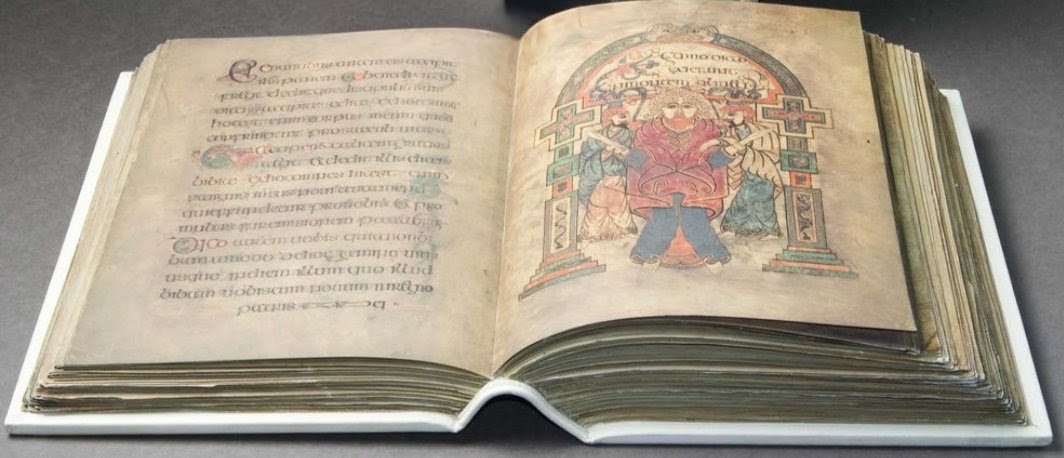
Book of Kells
The Book of Kells is housed at Trinity College. This book gave a creative jolt to pull Europe out of the Dark Ages brought on by the collapse of the Roman Empire which included the Roman Catholics. Ireland sent missionaries to the mainland of Europe.


The 1801 Copyright Act granted Trinity College Dublin a copy of every book published in the UK and Ireland. After witnessing the recent fire at Notre Dame in Paris, they realized that these ancient books could provide great tinder for a fire so they are cataloguing the books and updating their fire prevention measures.
Ireland Famine Museum

A water mold called Phytophthora infestans destroyed potato crops across Europe in the 1840’s. Only in Ireland did the crop failure turn into a massive, lethal famine. About 1.1 million people died out of a population of approximately 8.5 million. A further 1.5 to 2 million people left Ireland during this time. Ireland is the only country in the world whose population today is lower than it was in 1845.
“God sent the potato blight, but the English created the famine” captures the argument that while the crop disease was natural, the catastrophic loss of life was driven by British economic policies, inaction, and continued food exports from Ireland. Substantial amounts of grain, livestock, and dairy continued to be shipped from Ireland to Britain while people starved locally.
I asked our guide if the British ever apologized for their role in the Hunger Years. At a state dinner in 2011, Queen Elizabeth began her speech speaking Irish (A Uachtaráin agus a chairde) and expressed deep sympathy and acknowledgment for the complex, painful history shared by the two nations. Not exactly an apology, but somewhat close to one.
Dublin Literary Pub Crawl


Brendan Behan said, “I’m a drinker with a writing problem”.


In Dublin’s Fair City
Where the girls are so pretty
I first set my eyes on sweet Molly Malone
As she wheel’d her wheelbarrow
Through streets broad and narrow
Crying cockles and mussels alive, alive o!
Chorus
Alive, alive o! Alive, alive o!
Crying cockles and mussels alive, alive o!
She was a fishmonger
But sure ’twas no wonder
For so were her father and mother before
And they each wheel’d their barrow
Through streets broad and narrow
Crying cockles and mussels alive, alive o!
Chorus
She died of a fever
And no one could save her
And that was the end of sweet Molly Malone
But her ghost wheels her barrow
Through streets broad and narrow
Crying cockles and mussels alive, alive o!
Chorus


We decided to eat dinner at The Duke prior to our 7:15. We arrived at 6:00 and after our meal at 6:50, we asked to see the menu. Our waiter said, “No. The kitchen is closed.” What? He further informed us that the kitchen closes at 7:00. We were denied yet again. Maybe he didn’t think that we needed it!
Maybe our waiter was the 7th son of a seventh son which the Irish believe can see into the future. I say this because when we arrived at our hotel, we joined four others on the elevator. However, an alarm sounded and the doors wouldn’t close. An alarm sounded and the digital display said OVERLOAD. So we had to get on another elevator!!
Leave a Reply