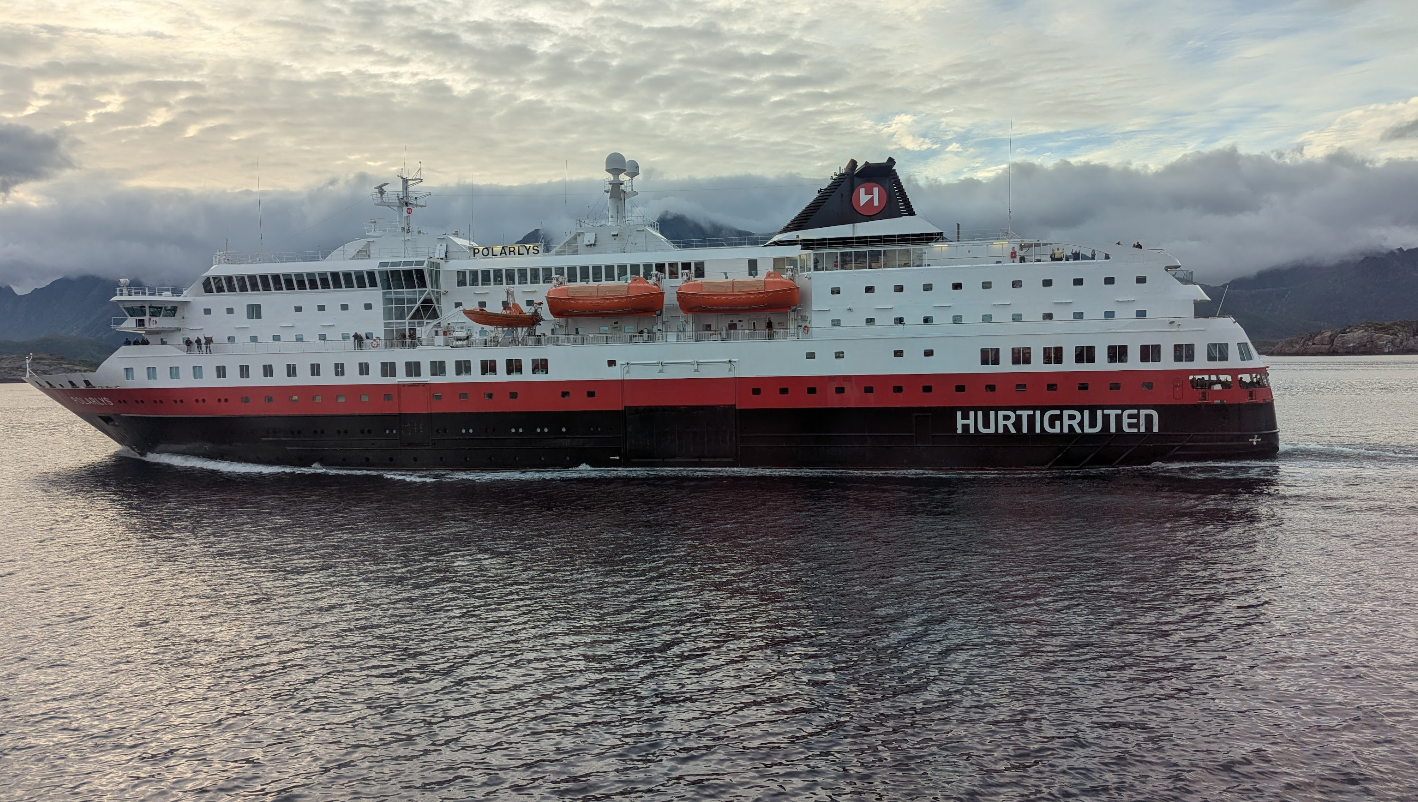
At Risøyrenna, the captain has to steer by hand due to the narrow channel. This manmade channel was dredged in 1922 between the islands of Hinnøya and Andøya. It was needed for transporting fish. Previously, they had to travel a long way around Hinnøya, the largest island in Norway.


They learned how to dredge from the Panama Canal. When the channel was finished, there was a huge parade with a Hurtigruten ship leading hundreds of fishing boats as well as the King of Norway. (The Norwegian word for king is kong. So I guess King Kong might apply?). The channel is 300 feet wide, 3 1/2 miles long, and 20 feet deep. Our ship, the Kong Harald has a draft of 15 feet.


It took eight years to get a sailing route established. Railways were difficult due to the mountains, and roads were dangerous due to winter. It would take ½ to 1 year to reach cities because of snow.
When sailing ships were used, shipwrecks occurred. There were no lighthouses.
They had a worker called the Ship Pilot whose job was to look for ships. Hurtigruten required a ship pilot. The ship pilot was always part of the crew for the polar explorers, Amundsen and Nansen.
The first coastal express run was from Bergen to Kirkenes in 1908. The first tourists came from England. German Kaiser Wilhelm came to Norway many times so the next tourists were from Germany.

However, in WWII, the Germans sank 13 Hurtigruten ships on their regular route resulting in the death of 700 passengers. Many fishing villages and coastal towns were bombed, and the Germans employed a scorched earth retreat so that the Russians wouldn’t get the supplies. The Russians pushed the Germans back to Tromsø, and then the Germans fled the country.
In the 1950s, northern Norway needed to be rebuilt. If no one lived there, the Russians would take over the land.
People were given 100,000 kroner to rebuild. Hurtigruten was needed to bring supplies. The men lived in Sami style homes until they were able to build a house to bring their families back.
People love Hurtigruten and can watch a minute-by-minute program on YouTube like you are on board. It is slow TV, or one can watch a sped up version.
People came out when we passed or when we docked which meant more flag waving.


Today Hurtingurten has split into Coastal Express and Expeditions. Hurtgruten has built its last fossil fuel ship. The next ship will be powered by solar panels and wind shields. These shields can be retracted when going under a bridge. By the way, all bridges are high enough for boats to travel under. There are too many boats for raising and lowering drawbridges.
Hurtigruten Museum
The Finnmark was the coastal express ship that sailed from 1956-1992. Afterward it sat at the dock for several years near the Hurtigruten headquarters. So they decided to build a building around it and make a museum.


We went through Trollfjord again, but this time was during a bright, sunny day when we could see eagles soar above the 3,000-foot-high mountains.


about the 99th.
99th Battalion US Army
In 1942, it was decided to create a very special unit in the US Army. Everyone who would join the unit had to be able to speak Norwegian. Thus, the unit consisted of many Norwegian-Americans, but even though they had mastered the language, few of them had ever been to Norway. They were specially trained in sabotage missions and were deployed in the autumn of 1944. They participated in the liberation of northern France, the Battle of Aachen, and the Battle of the Bulge.
The museum curator wanted to show me something very interesting.


Time and tide waits for no man.
Geoffrey Chaucer

Leave a Reply