We arrived at Honningsvåg on the island of Magerøya. Honningsvåg is considered the northernmost city in the world (at least that is what THEY say). There is a big controversy about it. Norway said that one needed at least 5,000 inhabitants to make the claim. Honningsvåg had only 3,000 so the honor went to Hammerfest with a current population of 11,000. However, there was such an outcry by at least 3,000 people that Norwegian officials said they could both claim this honor.

In Norway, remote cabins are called “hytter”. These simple rustic cabins are a significant part of Norwegian culture and are used for recreation and escaping everyday life. Hytters were a good place to hide from the Germans.
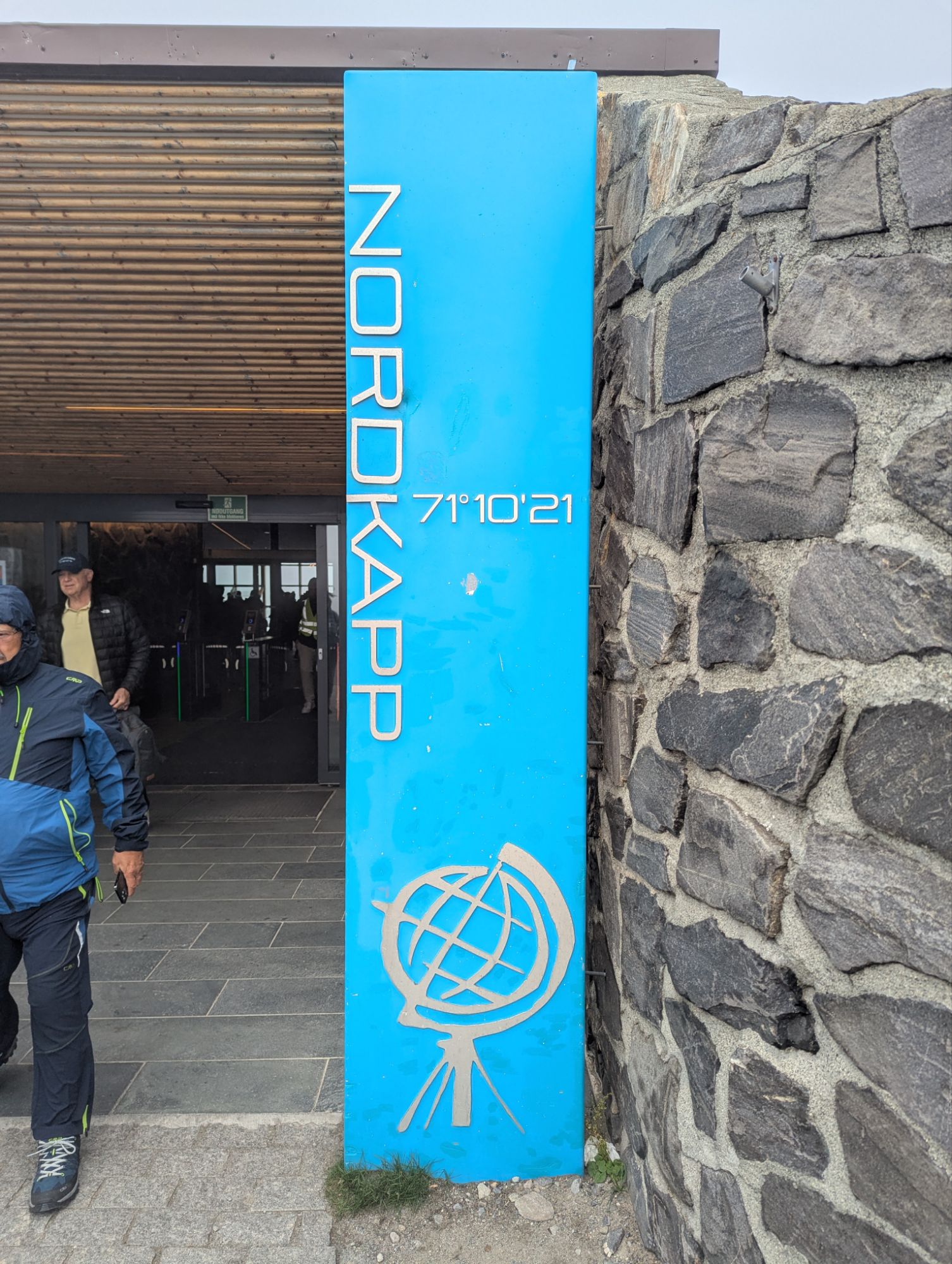
On Magerøya Island we traveled to the North Cape (Nordkapp in Norwegian). We boarded one of four buses in Honningsvåg from our cruise ship. There were probably ten more carrying passengers from other cruise ships.
The landscape is very different here. We are above the tree line. Even though it is barren, it is still very green with moss and lichens. There are four fishing villages on the island. In 1958, Honningsvåg had their first roads which made it much easier to go to the North Cape. In 1999, tunnels were constructed to the islands.

On the drive to the North Cape, we had a Brazilian guide. How can that be? She said that love brought her here. Three thousand residents of Honningsvåg represent 46 nationalities. Two are Brazilian, our guide and her son.
They have a lot of delicious King Crab. China can’t get enough. Portugal and Spain import 37,000 tons a year. These are delicious invasive species. Each female releases between 50,000 and 500,000 eggs annually with 30% making it to maturity.
She was proud to show us the one and only gas station which is beside the grocery store. The store is a great dating spot because one sees all the residents there.
Nordkapp marks the northernmost land in Europe (or does it?). A globe marks the spot.


I was really interested in the Children of the Earth monument found at North Cape. It was so foggy that I couldn’t find it!! But there is a small plaque showing the spirit of the monument.
In 1988 seven children from different parts of the world were selected at random by the author Simon Flem Devold and flown to the North Cape. Each child made a clay relief, and in 1989 these were enlarged, cast in bronze, and erected in a semi-circle outside the North Cape Hall.

The seven children were Jasmine from Tanzania, Rafael from Brazil, Ayumi from Japan, Sithidei from Thailand, Gloria from Italy, Anton from Russia and Louise from the USA. The aim of the project was to show that children can understand each other, work together, and have fun together regardless of skin color, religion, and cultural background.
The annual award of the Children of the Earth’s Prize is a substantial sum of money given to a person, organization, or project working to promote the living conditions, quality of life, rights, and health of children.
In 1959 there was a local boating accident with many lives lost from families that left behind 24 orphans and 4 widows. It was decided that only two family members should be on the same boat in the future.
Puffins arrive around mid-April and leave by the end of August. They each lay one egg in the spring, and one million chicks are born here. Puffins return to the place they were born. These sea birds live most of their life in the ocean. They are good swimmers and can dive up to 150 feet deep.
Jobs processing cod involve even the young. They bait hooks and slice out the tongues. The pay is as much as $17 per hour during the January-April cod fishing season.
Cod almost went extinct in the mid-1970’s to the mid-1980’s. It was determined that low herring numbers had a huge impact on the number of cod. Now there is a quota system.
Honningsvåg was once called Little Chicago because there were fights over women with blonde hair and blue eyes. Norwegian men didn’t want to share their women so there was lots of fighting over the few women that were here.
Artists come here to experience the blue hour which is a period of twilight before sunrise or after sunset when the sky exhibits a deep blue hue. This phenomenon is most noticeable in regions with prolonged darkness, like Northern Norway during the Polar Night, where it’s the only natural light available for several hours.
The government of Norway is giving money to parents in order to boost the falling birth rate. Honningsvåg is having a baby boom. There are 50 students in kindergarten and only 90 in the entire school, and 15 babies will be born this year. This is big news all over Norway.


Leave a Reply