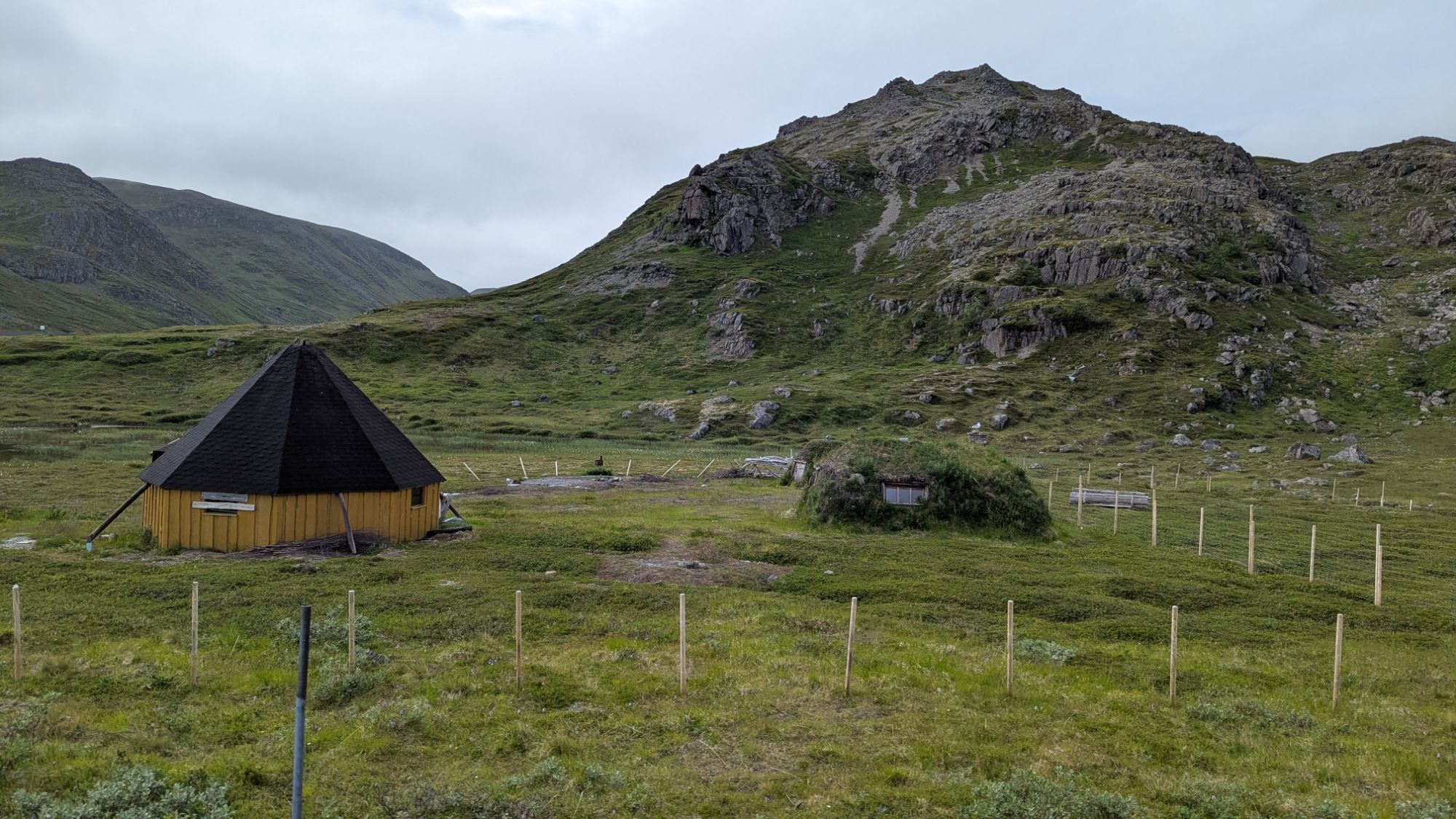
The Sami people originated from Northeast Russia around 6,000 years ago. They are the only remaining indigenous group in Norway. The majority of the Sami people live in Norway. Nine different Sami people groups exist, and they speak different languages. There are Sea Sami people and reindeer herding Sami people.

Nearby there are Sami UNESCO petroglyphs which date back to 6200 BC. They illustrate snow, boats, sledges, and water. In ancient times, they moved the petroglyphs to higher ground as the water began to rise. The reason is unknown, but likely it had some sacred significance.
There are no written sources about the Sami people until 890 AD. Vikings came into contact with the Sami. People were fascinated with their culture and large family groups.
The Sami have their own calendar which follows eight reindeer cycles. When the snow is cold and powdery, it is easier for the reindeer to move and dig for food. They are herbivores. The antlers are shed every year by both males and females, but at different times of the year.
If it is rainy, ice forms, and it is difficult for the reindeer to dig for food. The snow must be powdery. If not, the Sami people have to them feed. This is becoming more common as global temperatures rise, causing more rain.

Reindeer have a special circulatory system that is stimulated while digging. Reindeer have the ability to change eye color: Blue in winter to see better in the dark; brown in summer to protect from the sun.


Don’t ever ask a Sami how many reindeer they have. It is like asking you how much money you have in your bank account? They won’t tell you.
The Sami people can move reindeer by ferry boats, tunnels, or swimming. The Sami like for them to swim so officials can’t count them for tax purposes. Reindeer are good swimmers. Their hooves have two toes that spread apart and push water aside.
The county of Finnmark is the core of the Sami area. In the 1900’s Sweden wanted Finnmark. It was the least populated so Norwegians moved there. The Sami people had to identify as Norwegians.
The Sami people have their own music style called joik. The traditional joik is sung a cappella. Joiks are used when moving reindeer or to call to other herders. The joik is about a person, place, or nature. Whoever the song is for or about, they own the song.
In 2018, a Sami girl won first in a singing competition. Our lecturer played this one for us. It has accompaniment for presentation purposes. Joik
The Sami people are nomadic herders who excel in skiing and navigating. Now they use snow scooters. They often work as guides. They have 300 words for snow.

The Sami people ask permission of nature. They often don’t get an answer, but they have acknowledged their use of the nature.


Sami koftes are a traditional authentic clothes with a long history, and only Sami people can wear them. Vivid colors of koftes can express both regional and family affiliation of Sami culture and identity. In the past, the kofte was an everyday garment, but today it is used more as a festive dress or on special occasions.
The kofte can identify a geographic region and even marital status. Square buttons means married and round mean single.
Every Sami man owns a Sami knife and wears it on his reindeer leather belt. It is a big day when a man gets his knife. It is used to mark the ear of a reindeer in a specific way that can be spotted from a distance and identifies the owner of the reindeer.
A sad period in the Sami history was when Norway was forced to become Christians during the Reformation of 1537. Their culture, language, traditional clothing were banned and their drums were destroyed. The 1600’s was a dark time for the Sami people, and they had no rights.
Churches were built on Sami land. Even if the Sami converted, they would still treated as slaves and inferior to others.
In the 1900’s artists became interested in the Sami people and their northern culture and the northern lights.
In 1989 the King of Norway issued a formal and official apology to the Sami people during a Sami parliament session. This parliament had been established in 1989.

Sami people have a say when it comes to issues that directly affect them, especially about minerals, mines and land. If it’s bad for the reindeer, it’s bad for the Sami people.
Right now the Sami people are upset about the wind farms that have been erected on the reindeer lands. The lands are state lands but the Sami people have complete rights to use the lands for their reindeer. The noise scares the reindeer. There have been demonstrations in Oslo.
A Sami TV station and Sami University now exist which help the Sami people to relearn about their culture. In the past, some were sent off to boarding schools and forbidden to speak Sami. Today they get time off from school for the reindeer migration.

Tromsø is the location where many people come to observe the northern lights. It also has an augmented reality Troll Museum.


Leave a Reply