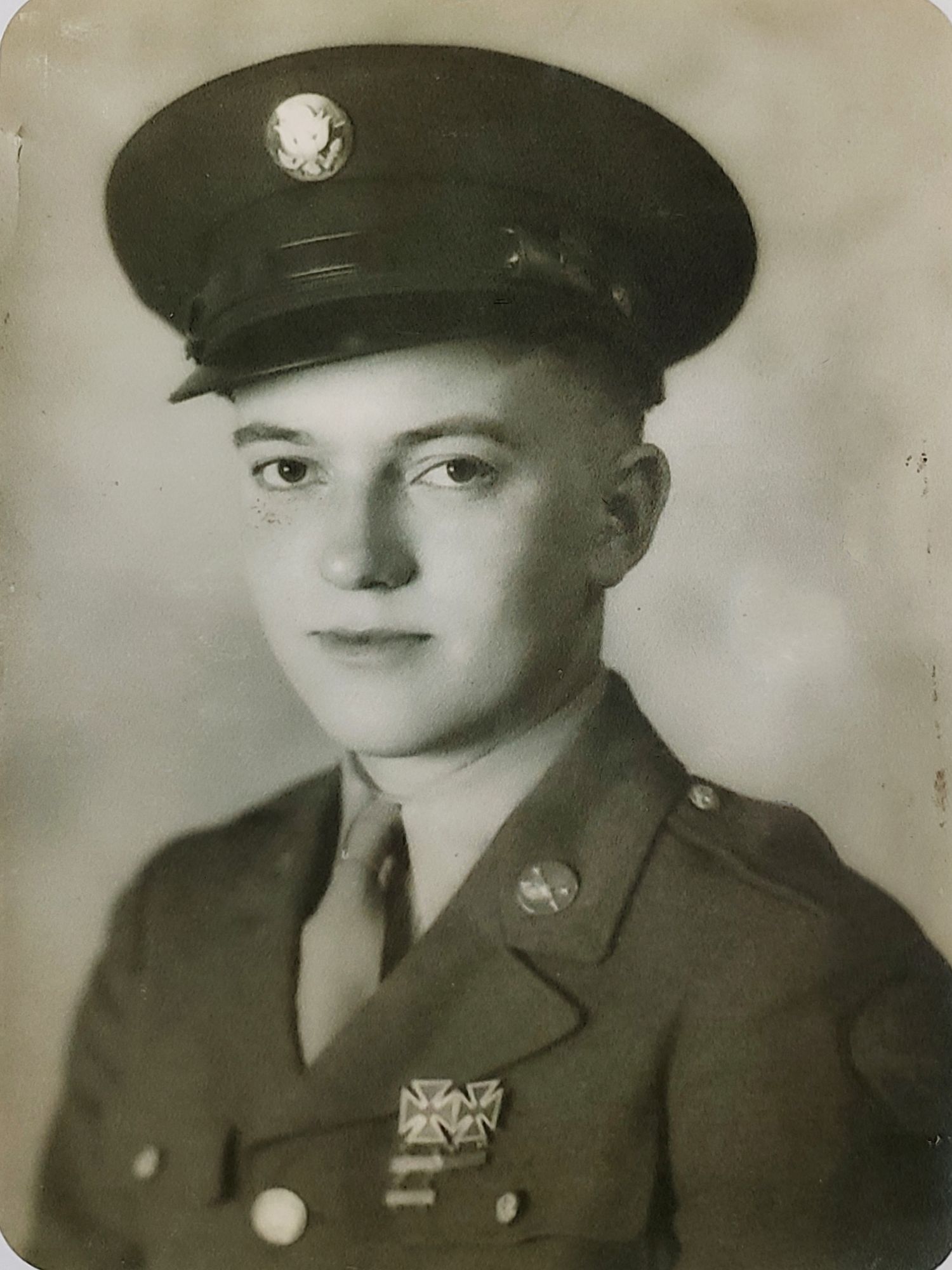
My father, Stewart Boone, was only 20 years old when he crossed the Atlantic Ocean in October 1944 as a soldier in WWII. The June D-Day offensive had been successful and the Germans were on the run.
After much training, a troop train took him from Camp Maxey, home of the 99th Division in Paris, TX to Boston, MA. Stewart boarded a Liberty Ship called the Exchequer which landed in Glasgow, Scotland 10 days later. The many Liberty Ships were traveling in a zigzag pattern to avoid any enemy German submarines. The food was bad, the air was stale, and seasickness was the order of the day. It was good to be on the top hammock. He was not! The hammocks were stacked five high. The latrines were busy and overloaded with all types of body fluids.
By contrast, our journey was by a jet (first seen by amazed American soldiers in Germany in the enemy’s attempts to bomb the Bridge at Remagen in March 1945. More on that later). Our first flight was 1½ hours from Norfolk,VA, to Atlanta, GA. The next flight was from Atlanta to Paris, France. It took eight hours. The food was good, we sat in sleepy rows, and no one got sick.
Stewart had never been further than 30 miles away from home. And he certainly had not been in a boat. He couldn’t swim. His family didn’t even own a car. And what did the army ask him to do? Drive a jeep!!
Stewart was told that he and his fellow soldiers were “Battle Babies” which meant they had not seen combat. His Division, the 99th, was headed to a quiet sector near the Ardennes Forest. They were told that they would likely be home for Christmas.
We are traveling on our own ETO (European Theatre of Operation) where we will join others to retrace the steps of our kinfolk who endured the unthinkable (which will be written in future posts) that occurred 80 years ago. I am told that a 100-year-old veteran will be in attendance. A living library!!
To prepare for this journey, we watched these movies:
- Band of Brothers – a well-done nine-part series focusing on individual soldiers.
- The Bridge at Remagen – the plot is not considered accurate, but the setting is real.
- Slaughterhouse-Five – weird; not recommended but written by a Battle of the Bulge survivor.
- Lee – an woman photographer’s view of WWII. Interesting but did not add much to our overall knowledge
- Battle of the Bulge – A classic. “General, do you realize what this means? It means that the Americans have fuel and planes to fly cake across the Atlantic Ocean. They have no conception of defeat.”
- Fury – raw, violent depiction of tank warfare.
- The Great Escape – a somewhat fictionalized story about an intricate escape from a POW camp that actually happened.
- Patton – Old Blood and Guts himself. A story of a brilliant military man.
- Judgement at Nuremberg – interesting movie about the aftermath of war and the responsibility of war crimes.
- Saving Private Ryan – only saw this once a while ago. The opening seen on D-Day is very impactful.
- A Bridge Took Far – often referred to as A Movie Too Long with an all-star cast depicting the failed British-led battle, Operation Market Garden.
- Mudbound – segregation in the south after soldiers of different races returned home.
- Enemy at the Gates – battle at the Russian front. Russia was not a member of the Geneva Convention so German prisoners and Russian prisoners were treated poorly by their captors on both sides.
- Dunkirk – British troops leaving mainland Europe and transported by Little Ships back to England.
And then we wanted to get into the mindset of the training of a soldier back in the 1940’s. On YouTube, we found:
- Private Snafu – animated training videos
- Venereal Disease – my dad said that these videos were horrible and therefore effective. My mom, who taught a Marriage and Family class, wrote the the army to inquire if she could show them to her students.
On the plane, the entertainment included Paramount+ which we don’t have at home. Much to our surprise, they were showing a six-part series called World War II: Battle in Color produced by the Smithsonian. They showed only three of the episodes, but they were very informative as it was actual colorized footage often explaining the German point of view.
Here are the titles of the Battle in Color series:
- Blitzkrieg
- Barbarossa
- El Alamein
- Kursk
- The Bulge
- Berlin
And then there were books:
- Once Upon a Time in War: The 99th Division in World War II by Robert E. Humphrey – This book was excellent, and I especially enjoyed reading the parts that my dad had highlighted.
- Combat Engineer – building bridges during the war and supporting the Allied war effort from an engineering standpoint. We are most interested in the Bridge at Remagen
Ready or not, here we come!!!
Leave a Reply